Deep Dive into FODMAP Types: Identifying Your Specific Digestive Triggers
Feeling overwhelmed by digestive issues? I'm breaking down the different types of FODMAPs so you can understand your specific triggers and start feeling better.
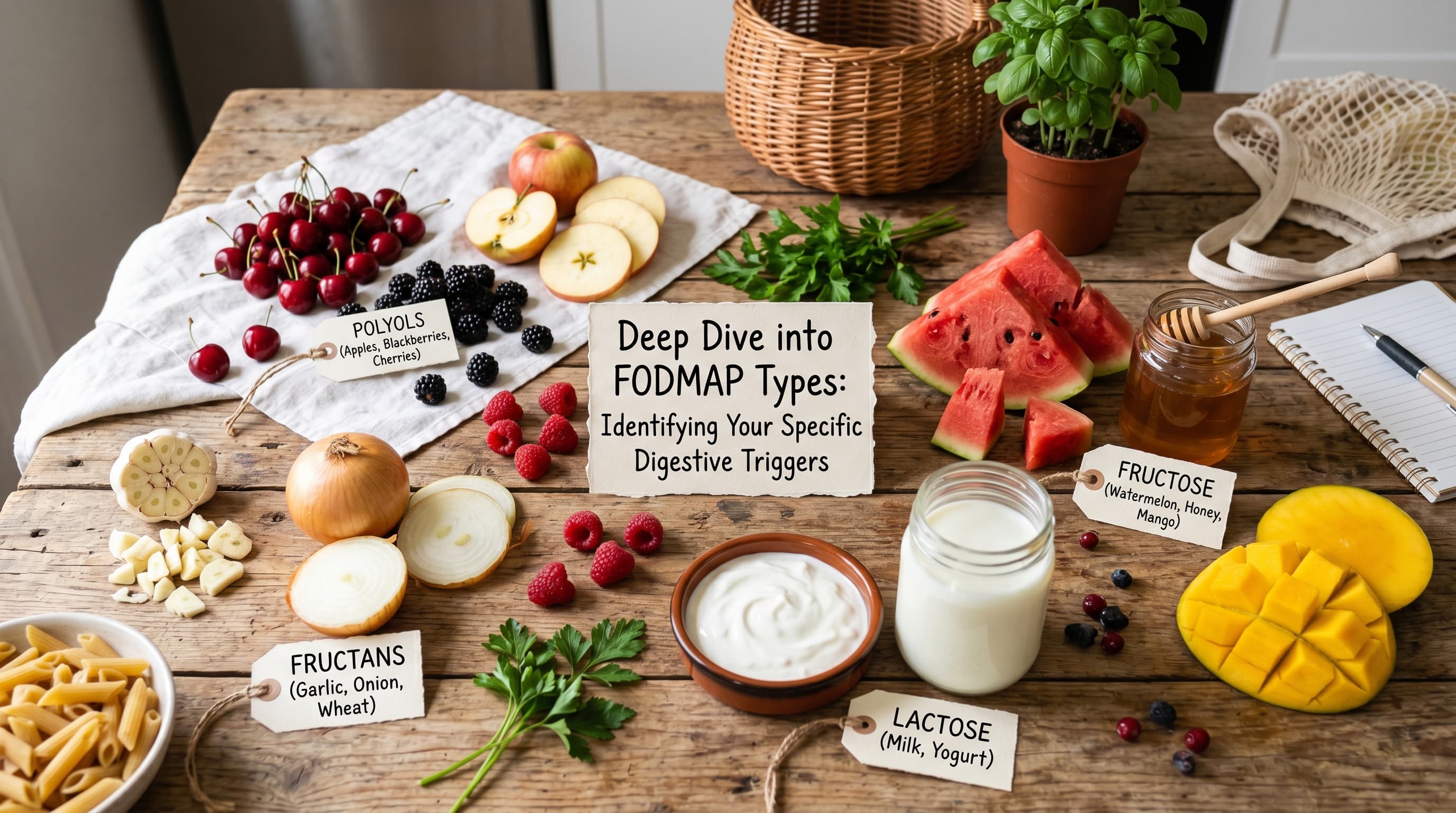
Deep Dive into FODMAP Types: Identifying Your Specific Digestive Triggers
Oh, the world of digestive struggles! If you've ever felt that frustrating bloat, discomfort, or unexpected bathroom dash after eating, you're certainly not alone. It's truly disheartening when food, which should bring us joy and nourishment, instead leaves us feeling unwell and confused. But I've been looking into this, and the good news is, understanding why certain foods cause trouble can be your first big step towards feeling better. Today, let's really dig into the different types of FODMAPs, so you can start to pinpoint exactly what might be triggering your unique digestive story.
What Are FODMAPs, Anyway?
First things first, let's demystify what FODMAPs actually are. The acronym stands for Fermentable Oligosaccharides, Disaccharides, Monosaccharides, And Polyols. Sounds like a mouthful, right? Basically, they're a group of short-chain carbohydrates that aren't absorbed very well in our small intestine. They're not inherently 'bad' or unhealthy foods, but for some of us, their unique properties can really stir up trouble in our sensitive guts.
When these FODMAPs travel undigested into your large intestine, a few things happen. They're like magnets for water, drawing extra fluid into your gut. This can lead to that feeling of fullness, cramping, and even diarrhea. Then, your gut bacteria have a feast! They ferment these undigested carbs at a super-fast rate, creating a lot of gas – mostly hydrogen and methane. This gas causes your colon to expand, almost like a balloon inflating inside you.
Why They Cause Trouble in Sensitive Guts
Now, here's the really important piece, especially if you experience Irritable Bowel Syndrome (IBS). For someone without IBS, a little gas and gut expansion might not even be noticed. But if you have IBS, you likely have something called visceral hypersensitivity. This means your gut is extra sensitive to stretching and distension. What might be a normal, unnoticed sensation for someone else can feel like significant pain and discomfort for you.
Getting to Know the Four Families of FODMAPs
One of the coolest things I've learned about FODMAPs is that they're not all the same. There are four main families, and each one behaves a little differently in your gut. This is fantastic news because it means you might react to one type but be perfectly fine with another! Let's break them down.
Oligosaccharides (Fructans & GOS)
Think of Oligosaccharides as tiny chains of sugars. This family includes fructans (chains of fructose molecules) and galacto-oligosaccharides (GOS) (chains of galactose molecules). The key reason these cause trouble is that our human bodies simply don't produce the specific enzymes needed to break down these complex chains. So, when you eat them, they travel largely undigested through your small intestine, heading straight for the large intestine where your gut bacteria are ready to feast. This fermentation process is what generates a lot of gas and can lead to bloating, pain, and changes in bowel habits.
You'll find fructans in some surprising places, not just wheat! Common culprits include:
- Fructans: Wheat, rye, barley (so many common grains!), onions, garlic, asparagus, artichokes, chicory root, and even some fruits like grapefruit and watermelon. (It's why garlic-infused oil becomes such a game-changer!)
- GOS: These are often found in legumes like beans, lentils, chickpeas, and some nuts such as cashews and pistachios. They're also naturally present in human milk, and research out of institutions like Monash University has shown their beneficial role in gut health for many, even while being a trigger for sensitive guts.
Disaccharides (Lactose)
Next up is Lactose, the sugar found in milk and many dairy products. The issue here often comes down to an enzyme called lactase. Lactase's job is to break down lactose into simpler sugars (glucose and galactose) that your body can easily absorb. For many people, particularly as they get older, the activity of the lactase enzyme naturally reduces. If you don't have enough lactase, the lactose remains undigested, drawing water into your gut and providing a ready meal for your gut bacteria, leading to fermentation and gas.
You'll typically find lactose in:
- Cow's milk
- Yogurt (especially plain, unsweetened varieties)
- Soft cheeses (like ricotta, cottage cheese, cream cheese)
- Ice cream
- Many processed foods, where milk solids or whey are ingredients.
The good news is that lactose intolerance is often dose-dependent. This means many people can tolerate small amounts, and some dairy products, like hard cheeses (cheddar, parmesan, Swiss) or lactose-free milk, are naturally very low in lactose or have the lactase enzyme added. Plus, certain fermented dairy products, like kefir or some yogurts, can be better tolerated because the fermentation process actually helps break down some of the lactose.
Monosaccharides (Excess Fructose)
This family is all about fructose, a simple sugar that many of us associate with fruit. While fructose itself isn't 'bad,' the issue arises when it's present in foods in higher concentrations than glucose. Our bodies have a specific transport mechanism for absorbing fructose in the small intestine, but this system works best when glucose is present to help it along. If there's too much fructose relative to glucose, that transport system can become saturated, leaving the excess fructose unabsorbed to continue its journey to the large intestine.
Foods that can be high in excess fructose include:
- Fruits like apples, mangoes, pears, watermelon, and cherries
- Sweeteners like honey and agave nectar
- High-fructose corn syrup (a common ingredient in processed sweets, sodas, and sauces)
It's a subtle but important distinction! Fruits like bananas, oranges, and blueberries are often better tolerated because they have a more balanced fructose-to-glucose ratio, or even more glucose than fructose. It's all about that natural balance within the food itself, which is why a 'low-FODMAP fruit list' isn't just a 'no-fruit' list!
Polyols (Sorbitol & Mannitol)
Finally, we have Polyols, which you might know as sugar alcohols. These include sorbitol and mannitol, as well as xylitol and maltitol. The challenge with polyols is a bit different: they're not malabsorbed due to enzyme deficiency or transport saturation like the others. Instead, they're simply absorbed very slowly and passively in the small intestine because of their relatively large molecular size. This slow absorption means more of them reach the large intestine, where they can draw water into the gut (osmotic effect) and be fermented by bacteria.
You'll often find polyols in:
- Fruits like apples, pears, cherries, peaches, plums, and apricots
- Vegetables like mushrooms, cauliflower, and snow peas
- Sugar-free gums, candies, 'diet' products, and some medications (always check labels for ingredients ending in '-ol' like sorbitol, mannitol, xylitol, maltitol).
This is where things can get a little tricky, as some foods, like apples and pears, are high in both excess fructose and polyols, making them double-whammy triggers for some sensitive guts. It's why specific, tested portion sizes are so important when you're exploring your triggers during the reintroduction phase.
Your Personal Detective Work: Identifying Your Triggers
Now that we know the four families, you might be thinking, 'Okay, but how do I figure out which ones bother me?' This is where the magic of the low-FODMAP diet's reintroduction phase truly shines. Remember, the low-FODMAP diet isn't meant to be a permanent way of eating. It's a structured, short-term diagnostic tool, designed to help you discover your unique sensitivities.
The Reintroduction Phase: A Gentle Process
After an initial elimination phase where you temporarily reduce all high-FODMAP foods, the next step is reintroduction. This is where you systematically test each FODMAP subgroup, one at a time, to see what your body can handle. You'll typically choose one food from a specific FODMAP family (like a small amount of avocado for polyols, or a specific serving of lactose-containing yogurt), consume it over a few days, and carefully monitor your symptoms.
It's a process of gentle discovery, not deprivation. You're giving your gut a chance to settle down during elimination, and then slowly reintroducing foods to see where your personal tolerance lies. It's like being a food detective, gathering clues about your own unique digestive system.
Why Individual Testing Matters
This individualized testing is so important because it's highly unlikely that you'll react to every single FODMAP type. Some people might find fructans are their main trigger, while others might sail through fructan challenges but struggle with lactose or polyols. By pinpointing your specific triggers, you won't have to restrict foods unnecessarily in the long run. You'll gain the freedom to enjoy as wide a variety of foods as possible, feeling confident and comfortable.
Practical Takeaways for Your Kitchen & Plate
So, what does all this mean for your everyday meals? The journey of understanding specific FODMAP types is really about empowering you to make informed choices. It's about finding delicious food that loves your gut back.
One of the biggest 'aha!' moments for many people is realizing that even if you react to, say, fructans, you don't have to give up all flavor. Take garlic and onion, for example. They're high in fructans, but their flavor compounds are oil-soluble, not water-soluble. This means you can create incredible garlic-infused oil or onion-infused oil by gently heating garlic cloves or onion pieces in oil, then straining them out before cooking. You get all the flavor without the FODMAPs! Similarly, the green parts of spring onions or chives are generally low in FODMAPs, offering a lovely oniony kick.
When you're exploring recipes, look for ones that thoughtfully consider these nuances. For instance, our GentleFeast Low-FODMAP Chicken & Bok Choy Stir-Fry uses garlic-infused oil and fresh chives to get that savory depth without triggering symptoms. It's a fantastic example of how you can enjoy vibrant, flavorful Asian cuisine while respecting your gut.
Another great option is our Low-FODMAP Vietnamese-Inspired Chicken & Rice Noodle Soup, which also leans on garlic-infused oil and spring onion greens to build flavor. And if you're looking for something different, our Low-FODMAP Grilled Chicken & Mushroom Skewers with Cucumber Rice thoughtfully uses oyster mushrooms, which are often tolerated in small portions, and again, garlic-infused oil for that delicious taste.
Remember, it's not about cutting out entire food groups forever. It's about:
- Reading labels carefully: Especially for polyols in 'sugar-free' products or hidden fructans in processed foods.
- Paying attention to portion sizes: Sometimes a small amount of a high-FODMAP food is fine, while a large serving causes trouble.
- Exploring alternatives: If cow's milk is an issue, try lactose-free milk, almond milk, or oat milk (checking for oat milk brands low in FODMAPs). If apples are a trigger, maybe oranges or blueberries work perfectly for you.
The research is still evolving, but we're learning more and more about how different cooking methods or food preparations can sometimes alter FODMAP content. For example, sourdough bread, due to its fermentation process, can sometimes have lower fructan levels than regular wheat bread.
The journey to understanding your gut is a personal one, and it's always a good idea to partner with a registered dietitian who specializes in FODMAPs. They can guide you through the process safely and help you build a personalized eating plan that feels joyful and nourishing.
You've got this! Understanding the different FODMAP types is a powerful step towards taking control of your digestive comfort. It might feel like a lot of information right now, but every little bit of knowledge helps you become a better advocate for your own well-being. So, let's celebrate this newfound wisdom, and remember that even small, intentional steps can lead to huge improvements in how you feel. Why not try experimenting with a garlic-infused oil this week? It's a simple change that can bring so much flavor without the fuss!